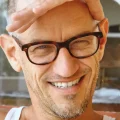
Jouko van der Kruijssen was born in Amsterdam, not in a church, exactly, but in his parents’ home attached to the church where they were caretakers. Early on, he found a different temple: the natural world.
“I must have been five or six when I started reading all the animal books, the kids’ science books in the local library,” he tells The Frisc. “And when I finished those, I quickly moved on to adult biology books. I would regularly go to the zoo in Amsterdam, but I never enjoyed it as much as wild animals. Seeing a hedgehog in the wild was way more exciting than seeing an animal at the zoo.”
When van der Kruijssen was 4, his teacher’s report noted that he was “very interested in all the little things that crawl, the bugs and the worms and all that stuff,” he says with a laugh.

There are many wild places in the Netherlands — sand dunes, forest, heath — but Van der Kruijssen was equally entranced by, and keenly observant of, the wildlife in his hometown: “In Amsterdam, we would go feed the ducks, and one season I noticed that, hey, there are different species in the winter than in the summer.”
Now a San Franciscan, van der Kruijssen (pronounced “KROY-sun”; his first name is “YOW-ko”) layers his meticulous thrill for the natural world with the stillness and reflection of a churchgoer to create delightful and revealing photographs of urban wildlife. His work is both beautiful art and a living document of the sometimes bucolic, sometimes tense admixture of the urban and the wild.

Van der Kruijssen has been in the States for 15 years, working as a graphic designer and more recently doing event photography and portraits to make a living. He didn’t start photographing animals right away. He would take the occasional trip out of the city, to Yosemite, for example, but he wasn’t looking around at daily life.
The scales fell from his eyes one day in Alamo Square. “It was actually hummingbirds I started noticing,” he says. “I was just looking at the view and I saw them buzzing around the trees and I thought, ‘Oh yeah!’ You could hear them, they’re on the power lines. I can thank the hummingbirds for sucking me back into what goes on around me.”


Starting with hummingbirds was good training: “How to approach an animal without disturbing it because if you disturb them, they’re gone.”
Soon he was taking his camera during lunch breaks to Yerba Buena Gardens to practice on “boring birds,” seagulls and pigeons washing themselves in the fountains. “I was partially looking for new species or new behavior and partially just practicing to get to know my camera and get in my, what is it, 10,000 hours before you master.”
By land and by sea
The first mammal of note that he photographed was the otter, dubbed Sutro Sam, that took up temporary residence at Sutro Baths in 2012. He got there the day after the first news report, “before the hordes.” He lent his observation skills to the River Otter Ecology Project, taking notes on “everything it was doing pretty much every second, like how many fish it would eat, how long it would dive, how many times it would go into its den, and all that stuff. From that data it’s clear that the frequency of fish that it caught per unit of time was going down.”

Like many people whose craft requires observation, notation, and repetition, those practices for van der Kruijssen tap into a deeper state. “When we used to live in caves, that was all seasons, leaves, bird songs, all kinds of stuff that automatically gets absorbed into your head, all valuable information,” he says. (In modern life, he says, it’s all jingles and random information that gets stuck in our heads.) “Going out in nature is using that time to refill my brain through osmosis or whatever, unconsciously getting all this information. Movement to the same spot over and over again becomes like a second nature or a first nature or something like that, and then planning a shot is more natural. You know intuitively where to go, what to do to take a shot. Anticipate where the animal will be and where it will go.”
“Sometimes people run after an animal with their phone. If you do that, the best shot you’re going to get is the tail end of an animal running away from you.”
And when a shot doesn’t work out? “You get to hang out in nature, which is a great thing for me. It’s never time wasted.”
“I just see gulls”
Van der Kruijssen thinks a lot about the ethics of wildlife photography. Some photographers feed or call animals to entice them for a photograph. Some “wild” shots are in fact animals raised on game farms then posed for pictures. He supports initiatives like the North American Nature Photography Association’s call for “truth in captioning” to note if an animal was baited or not actually wild. “As far as I know, it’s pretty much illegal everywhere around here to feed wildlife, but I still see people do it now and then, where they toss something at an animal to get it close to their lens.”
Being out so much also means promoting good practices, mindfulness, and straight-up respect to all kinds of citizens. It can be as simple as people seeing one of his pictures, like plovers at Ocean Beach.

“Someone saw them and was like, ‘Even though I work here every day, I never realized there’s all these different birds going around. I just see gulls!’” He also hopes his pictures can highlight the impact of off-leash dogs on Ocean Beach who chase the shore birds, which need time to rest and save energy.
When he’s outside, people often approach to ask what he’s shooting. “And I can tell them about that animal and they say, ‘Oh, I never knew that was there.’ That’s probably the most important thing to me, to get people excited about things they didn’t know are happening right under their noses.”
“There’s always a discussion around coyotes. They have a terrible reputation that they don’t deserve, but there are also actual conflicts.” Van der Kruijssen says he’s seen people feed them or encourage their dogs to play with them, and the coyote takes the blame when something goes wrong.
Difficult conversations
So far, uncomfortable situations have turned out for the better, like the man at Sutro Baths who wanted to dump a store-bought trout into the pond for the otter; or the man on the beach who brought a spotlight to help capture a rare burrowing owl that had taken up residence. “I was like, “Are you with the zoo?” and he was like, “No, my friend just told me. He knows a lot about owls.” And I go, “Well, this is a burrowing owl and this is what it does. It’s actually been here in previous years. You’re going to harm it if you do whatever you plan to do.’ It was good that I was there. A couple days later I saw him and he had brought his little son and they were like, ‘Look, but we must keep our distance. Look, there’s the little owl!’ And they were having a great time.”

As in many dense European cities, cars in Amsterdam often take a backseat to pedestrians and bicycles. In the same way, San Francisco immediately appealed to Van der Kruijssen when he arrived, especially after visiting other American cities: “Coming from Amsterdam, I need to be able to use public transportation or walk places or ride my bike.”
He still doesn’t have a car. To get to shoots outside the city, he relies on SamTrans, BART, Golden Gate Transit, Caltrain, and his feet. It’s not a bad walk from Redwood City’s train station to the bay mudflats where black skimmers feed.
Van der Kruijssen will take one bus route, hike up a mountain, shoot all day, then hike down the other side to catch a different bus home. The transport network in San Francisco and surrounding communities isn’t perfect, but it’s better than when van der Kruijssen arrived. He can’t help but feel there’s something missing, however, and, like so many of his fellow San Francsicans, expresses rueful nostalgia. When he first came to the city (following a girlfriend) he hung out with college students in South of Market warehouses and art spaces. He had found a community. Now, he says, “I’m a little more alienated by the city. It doesn’t feel quite the same.”

But change cuts both ways. In less than two decades, the city and its highest human population ever has learned to accept, live with, and even love a wider and wilder array of critters — coyotes and hummingbirds and owls and otters, raccoons and skunks, foxes, hawks, and herons — not seen in generations.

In pursuing a passion awakened early in his hometown of Amsterdam, Jouko van der Kruijssen’s wildlife photography makes the coexistence all the richer. He opens our eyes to wonder, possibility, and responsibility. We San Franciscans — two-legged, four-legged, winged, and otherwise — are all richer for it.
Find more of Jouko van der Kruijssen’s photographs at SF Wildlife.