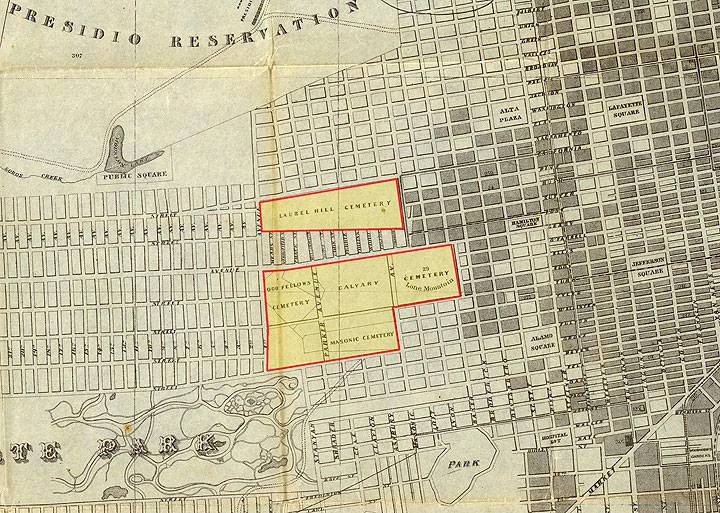
There’s a common bit of lore around San Francisco’s cemeteries. It holds that in 1900, Mayor James Phelan outlawed them, and so most decamped to Colma.
It’s not true. Phelan outlawed new burials, which spurred an exodus. Local campaigns to drive out cemeteries — ostensibly to protect public health, but really to free up real estate — added accelerant.
If you’re trick or treating this week, or just getting into the spirit of the season, you can still take a tour of where many former cemeteries used to be. Join us to find out where the bodies were buried, and where some still might be.
This brief excursion through the Inner Richmond, Laurel Heights, and Lone Mountain takes less than an hour and covers mostly even ground, although you may want more time to explore a few landmarks open to the public along the way.
Buried treasures
In the early 20th century, San Francisco was spreading ever westward, and those burial plots were not just taking up valuable land but also potentially driving down the value of adjacent parcels.
Laurel Hill Cemetery, originally Lone Mountain Cemetery, was the last holdout, evicted by voter initiative in 1937.
But not everybody — or shall we say, every body — left. In 2016, a Lone Mountain woman doing renovations was shocked to discover under her home a century-old casket with the remains of a young girl. A year later, a neighbor discovered a discarded tombstone.
These were hardly the first: The Asian Art Museum found dozens of skeletons during a 2001 excavation of its Civic Center haunts. And eight years before that, more than a thousand skeletons turned up beneath the Legion of Honor.

Barry M. Deep, indeed.
“There’s no way they got everything,” Odd Fellows historian Peter Sellars tells The Frisc. “People find bones, people find skulls. I expect them to find more.”
Most caskets have disintegrated over the centuries, says Sellars, but dig around near these sites and others and you might find coffin nails, jewelry, and even dental work from long-lost burials.
Recovering all remains would mean “tearing up a whole bunch of houses,” Sellars adds, so most will stay undiscovered unless a hapless homeowner happens to renovate in the right (or wrong) spot.
And yes, now that you mention it, this is the plot of the 1982 film Poltergeist.
I am stretched on your grave
For our out-of-body outing among long-gone graveyards, we referred to a 1873 map of the “big four” Richmond burial grounds.
The tour requires imagination, not only to picture remnants of San Francisco souls underfoot, but also to reconcile inconsistent boundaries and retired street names. (Back then, Arguello Boulevard was still 1st Avenue.)

We get our bearings at our first stop at the corner of Arguello and California Street. To the north, the spire of the historic St. John’s Presbyterian Church shares the skyline with the stately dome of the Congregation Emanu-El temple across the street.
California Street once hosted a plaque to mark one edge of the old Laurel Hill Cemetery, which was bounded by California, Geary Boulevard, Presidio Avenue, and Parker Street. The plaque was “half hidden by a hedge,” according to the local history site NoeHill.

“The builders of the west, civic and military leaders, jurists, inventors, artists, and eleven United States senators were buried here,” the marker boasted. But by 2012 the plaque had disappeared.
When founded in the 1850s, Laurel Hill Cemetery was well beyond SF’s western boundary, surrounded by sand dunes and imposing wilderness. Nowadays it’s one of SF’s quietest, most expensive residential corridors.

Two well preserved remnants of an older city are on this stretch of Arguello.
On the west side, near Cornwall Street, sits the Campfire Girls Building circa 1929, designed by famed architect Henry Gutterson, who designed dozens of top-dollar St. Francis Wood homes.
It became a landmark in 1984 and is now home to a neighborhood preschool. Unfortunately, a high wall and gate obscure almost the entire structure from view.
One block south is Theodore Roosevelt Middle School, a fine example from the golden age of SF school construction and a product of Timothy Pflueger, still most famous for the soaring Pacific Bell building downtown.
Ashes to ashes
Continuing south on Arguello toward Rossi Park brings us to the edge of what was once the 167-acre Odd Fellows Cemetery. It’s anyone’s guess how many odd fellows might still be permanent underground residents, but plenty more are aboveground, stored in little boxes.
Turn east on Anza Street and find tiny Loraine Court, a — wait for it — dead end street. Here you’ll find the San Francisco Columbarium, one of the city’s most criminally overlooked landmarks.

This beautiful neoclassical throwback dates to 1898 and houses cremated remains. The crematorium, outlawed and destroyed in 1910, stood where Rossi Pool is now. But the Columbarium remains in operation, with a memorial garden whose monuments serve as birdbaths or as tributes to local landmarks like Coit Tower.
(The Columbarium is also home to one of San Francisco’s two “wind phones,” the other being found along the Great Highway.)
Head south on Arguello again to reach Golden Gate Park. Nobody’s supposed to be buried there — of course, you never know — but for a more historically reliable burial ground, head east up Fulton Street.

You’ll shortly glimpse the spires of St. Ignatius Church on the University of San Francisco campus.
The original St. Ignatius was built on the “outer dunes” of Market Street and Fourth Street in 1855 and relocated five times. The current building began construction in 1910, surrounded by the former cemetery. In 1934, what was originally the San Francisco College for Women was born. Two years earlier, the last bodies had been relocated.
Or so we thought. In 2011, construction work turned up human bones and, disquietingly, dozens of old caskets that were for some reason empty. Sellars says he knows where several more graves remain hidden on the USF campus. Nobody at USF returned requests for comment, although we can’t exactly blame them after being asked if they know where the bodies are buried.
‘Elaborately beautified’
Walk east across campus to Masonic Avenue and turn north. You’ll walk right by, yes, the onetime Masonic Cemetery and neighboring Calvary Cemetery. The university bought up the land in the 1930s.
California Freemason Magazine, which might be a wee bit biased, says observers reckoned the Masonic cemetery to be the most stately of them all on SF’s west side. (The defunct Morning Call described it as “elaborately beautified.”

It was at least the home of SF royalty — Emperor Norton himself, in 1880. (They definitely moved his body.)
There was at least one ghoulish incident on the site in the 1920s. A patch of land along Masonic Avenue was briefly the site of a baseball park, Ewing Field. Its wooden bleachers caught fire from a cigarette, taking down 100 nearby homes as well.
These days it’s a fine neighborhood, and plenty more homes now cluster around Ewing Terrace.
The touch of unseen hands
People have a lot of hangups about where human remains end up, so it’s not surprising that several sites we’ve passed, including USF and the Columbarium, are the site of local spooky stories. Columbarium visitors have sworn they’ve heard whispered voices and felt the touch of unseen hands.
But if you’re a homeowner worried about lonesome ghosts bringing down your property values, former cemeteries are the least of your worries, says Liz Clappin, host of the cemetery history podcast Tomb With a View. In western folklore, ghosts are usually linked to where they lived or died, both unlikely to be the place they’re buried: “The cemetery is just where the body is.”
Hopefully Inner Richmond residents can rest a little easier with that in mind — that is, those who aren’t already resting eternally.