Rosa Josephson has struggled for years with her mental health, especially after a series of strokes. She’s 86, and has often felt isolated, anxious, and depressed. But on a recent Monday afternoon, Josephson was lit up.
She and a small group of seniors, all Latinas 60 and older, sat around a table playing lotería, or Spanish bingo at the South East Mission Geriatric Clinic. Their laughter filled the room.
The session was one of the mental health services offered at the clinic, which is on Mission Street just south of Holly Park. Josephson has participated in one-on-one and group therapy there for 17 years.
“She gets depressed,” said Ellie Menendez, Josephson’s daughter. “I see the difference with her coming here.”
But by October that’s going to change. The Department of Public Health (DPH) has marked South East Mission Geriatric and two Tenderloin youth clinics for closure amid a $643 million deficit and what city officials call “the most difficult budget since 2008.”
The clinics have become a rallying point for unions and others against Mayor Daniel Lurie’s budget cuts. DPH says the three sites serve too few clients to justify keeping them open. But South East Mission’s employees, all of whom will be reassigned to other city-run sites, question the rationale. They say the seniors can get therapy elsewhere but risk losing a sense of community, an invaluable balm for their increasingly isolated age group.
‘Change can be difficult’
June is budget season in San Francisco. Threats of cuts swirled around City Hall leading up to the mayor’s two-year budget proposal to start this month. Some, like widespread layoffs beyond an initial 127 in April, haven’t materialized. The city has more than 34,000 employees.
Other cuts, like closing the three DPH-run clinics, remain on the table. The mayor’s team and supervisors will now negotiate through the month, but changes will be along the margins of the proposed $16.9 billion budget.

South East Mission is being shuttered because of what DPH calls “very low utilization” — about 14 clients a day or 200 clients a year. Closing it and two other DPH clinics and reassigning their 15 workers will save $2.5 million, according to a recent presentation at a supervisors’ hearing.
“SFDPH and the Mayor’s Office worked together to shield core services from the full effect of those reductions,” said a DPH representative in a statement emailed to The Frisc. “Recognizing that change can be difficult, the department wants to reassure clients and their families that SFDPH will continue to provide the same high-quality mental health care and support services for older adults and all populations that it serves.”

DPH says the seniors can get services at Mission Mental Health, the OMI Family Center, and Sunset Mental Health. All are city-run clinics with larger capacity. Mission Mental Health sees about 900 clients a year, and OMI Family Center about 650. Numbers were not immediately available for Sunset Mental Health. “These clinics will offer the same services as South East Mission,” the DPH representative said.
South East Mission workers and patients worry those alternatives will fall short in a number of ways.
First, they aren’t exclusively for seniors. Patricia Fernandez, 71, has been coming to the South East Mission clinic for a decade and worries about going somewhere “more crowded” with “people we don’t know.”

Geography is another challenge. Many South East Mission patients live in the Outer Mission and Bayview and depend on taxis or public transit. Mission Mental Health and OMI Family Center aren’t that far away — about eight-minute drives from South East Mission — but staff say the Mission Mental Health location (Mission between 23rd and 24th streets) makes it tricky for pickups and drop-offs.
Sunset Mental Health is on the city’s west side, at least 20 minutes from South East Mission by car or nearly an hour on public transit.
“The ladies here get so depressed,” says Menendez. “It takes a lot of work to get out of the house.” Adding commute time will mean some just stop coming, therapists say.

The clients tend to linger beyond the hours of formal therapy, because they often “have nothing to do at home,” says Francisca Oropeza, a South East Mission therapist for 25 years. “A lot of these people don’t have community around them, because some of them are very difficult. Family, after you get older, they don’t want to ‘deal with’ you.”
South East Mission’s focus on Latino seniors is also important. According to Oropeza, nearly everyone there speaks Spanish. The clinic also offers culturally familiar services, like lotería, that help these seniors feel less isolated.
Limited capacity
South East Mission is the last city-run outpost specifically for senior mental health.
The city has 569 mental health workers per every 100,000 people according to a 2023 study, and many are open to seeing seniors. But they are often in private practice, which can be expensive and less likely to accept Medicare, the public insurance for people 65 and older. Especially for South East Mission’s clientele, almost all lower income, this is prohibitive.
The DPH representative notes that “nonprofits contracting with the city can be a viable option.” A few nonprofit clinics focus on the senior population and accept MediCare, meaning services are more accessible.

But the same problems with location and specialization exist with these nonprofits too. And it’s uncertain how much capacity they’ll have to absorb the 200 South East Mission clients.
For example, the Curry Senior Center in the Tenderloin has four clinicians, and only one speaks Spanish. It typically only takes on around five new clients per month, according to behavioral health supervisor Jack Spohn, who added that even 20 new patients would overwhelm the center. “We’re a smaller nonprofit. We’d love to get to all of them, but we are limited with our own staff.”
“No single organization can replace the role of a specialized public clinic,” said Miki Lamm, director of the Jewish Family and Children’s Services’ Seniors At Home program. She said that changes like the coming closure “emphasize the importance of having a strong network of providers serving older adults in San Francisco.”
Nonprofits are also facing budget cuts. Curry is slated to lose nearly $181,000 in city funding by fiscal year 2027-28. The Felton Institute’s program for socially isolated older adults will be cut by the same time, saving DPH nearly $1 million.
‘Numbers game’
Critics say DPH’s use of low patient volume to justify the clinic closures relies on faulty data.
The problem is with Epic, the billing software widely used in health care, according to South East Mission’s Oropeza and her colleague Stephanie Gonzales. They said the billing codes don’t accurately capture the scope of their work, and now they’re being penalized for it. “We’re getting closed down because we don’t bill enough,” said Oropeza. “It’s really this numbers game.”
It’s easy to bill for mental health services like therapy, but it’s harder to accurately log (and therefore be paid for) case work outside of therapy sessions, like taking clients to the grocery store, helping them cash checks, or making sure they understand their medical doctors. The hours add up, but Oropeza and Gonzales said they cannot bill for travel time.

Epic provides these options for billing, says Garen Corbett, director of UC Berkeley’s California Health Benefits Review Program, but it’s up to the organization — in this case the city or county health service — to customize it properly.
Other clinics like Curry successfully capture these nuanced tasks in Epic. But Curry has dedicated staff for these tasks and their hours are billed differently than a clinician’s, says Spohn, the behavioral health supervisor from Curry: “If I were to take a client to the DMV, how the heck would I bill for that?”
Gonzales says no one from the city trained them to use a mental health or social work version of Epic — only a medical version, geared toward doctors and nurses, which she describes as “slapped together.” (Some DPH savings in the proposed budget come from completing a switch to Epic from a different billing software, saving $300,000 by fiscal year 2027-28, plus another $5 million in IT reductions.)

South East Mission workers say they raised this concern last year but were told, “‘Don’t worry about Epic, don’t worry about your numbers, just practice.’ This was email after email and staff meeting after staff meeting,” says Oropeza.
She and others say that not logging these extra hours helping clients outside the clinic has led to the low numbers used to justify the closure.
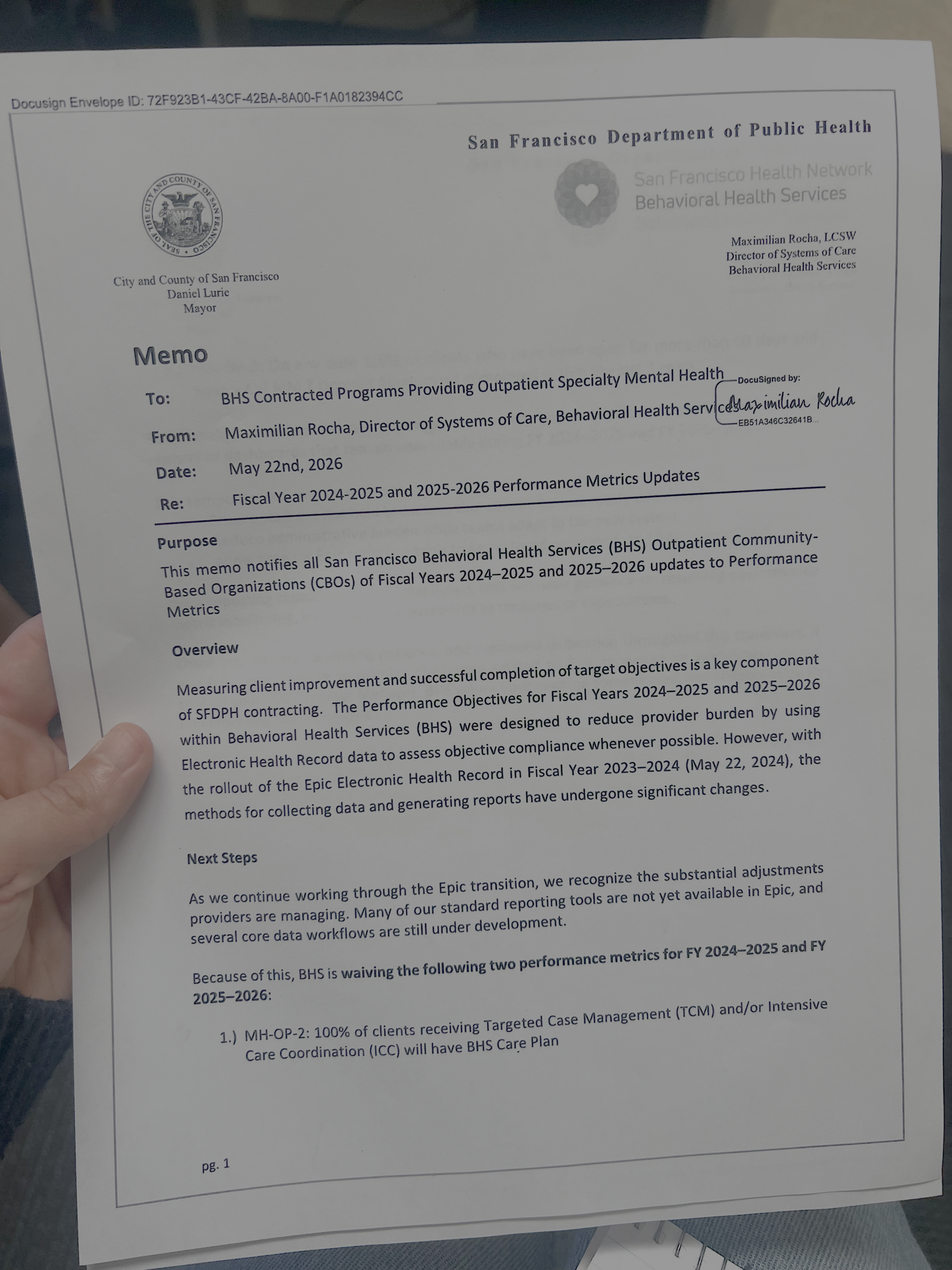
She showed The Frisc a May 22 letter from DPH acknowledging the problem and waiving some of these case management performance metrics. But by then South East Mission was already slated to close.
Asked about the Epic problems and the May 22 letter, a DPH representative told The Frisc that the department “conducted a full and thorough analysis of service utilization at all SFDPH mental health specialty clinics prior to making the difficult decision.”
Cuts and shifts
DPH director Daniel Tsai told supervisors this week that the majority of cuts to his department are driven by HR 1, the 2025 Republican “Big Beautiful Bill” that came with substantial MediCal reductions.

In response, the city is rearranging its dollars in complicated fashion. Total DPH funding is actually increasing from $3.3 billion to $3.7 billion to keep services afloat, including $39 million more for behavioral health. Some of this will be used to help immigrants kicked off of MediCal move to the city’s public health care plan.
“That is a huge amount of support that San Francisco is putting into the safety net and public health, without which we would be tanking,” Tsai said. But he added that the boost “won’t be felt,” because it’s going to be used to backfill the loss from federal and state cuts.

Amid all this, Oropeza and Gonzales fear the senior mental health specialization is being subtly stripped away from San Francisco’s publicly-funded offerings.
They and other South East Mission workers have gotten their reassignments but say they’re not allowed to take their clients with them. Spreading out the services is “diluting and in effect eliminating” their specialization. DPH says that’s not so: “If their patients wish to follow their clinician to the new clinic, they may do so.”
DPH emphasizes that the South East Mission clinic closure does not mean any loss of specialized jobs, just reassignments: “All of the SFDPH clinics impacted by the consolidation already provide specialty mental health care services to older adults … Bringing staff together will help strengthen services, improve coordination, and support a smooth continuation of care.”
The workers are part of a weeklong rally at City Hall to protest budget cuts, but there’s been no sign of change to the decision to close the clinic. It leads the clinic’s Stephanie Gonzales to make an appeal that most people can relate to: “There’s one thing that we all have in common in this world, and that’s that we’re all going to get old one day,” she said. “God forbid this should happen to your mother.”
Correction (6/19/26): The original version of this story misstated when South East Mission staff could bill for travel time.