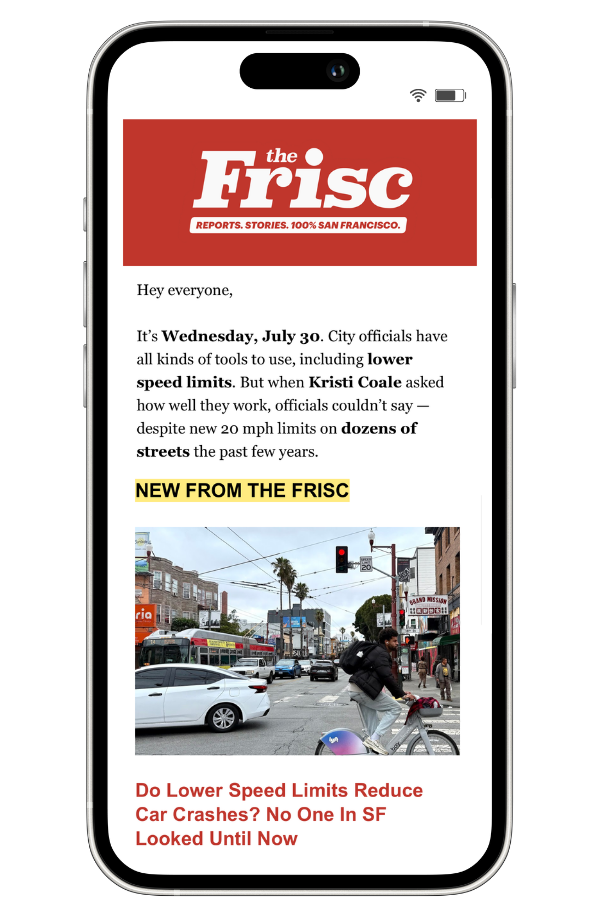
San Francisco now has 17 “slow streets,” where cars are expected to drive with extra caution and create space for pedestrians, bikes, and others. But street safety advocates feel that officials are too cautious in making changes, and they’re frustrated with the city’s lack of data.
They’re taking matters into their own hands with the help of the top Yelper — that is, the SF-based rating site’s chief executive and cofounder, Jeremy Stoppelman.
Stoppelman, a big backer of last fall’s successful ballot measure to keep JFK Drive closed to cars, is now footing the bill for a private yearlong effort to measure traffic on nine SF streets.
It will deploy 50 camera counters that can distinguish among trucks, cars, and other vehicles, as well as pedestrians, bicyclists, and scooters, and check their speeds.
Separately, there’s another citizen-led effort to gather traffic data that compiles crowdsourced reports of close calls. The SF Near Miss Dashboard launched May 1, and is the handiwork of two local software engineers.
Both projects were born from exasperation with incomplete data from the SF Municipal Transportation Agency and other city agencies. “We need to ensure our slow streets are actually slow and safe, so we can meet our sustainability and Vision Zero goals,” Stoppelman tells The Frisc, the latter referring to the city’s failed effort to eliminate traffic deaths by 2024.

Last year’s 39 deaths were the highest since the Vision Zero pledge was made in 2014.
Slow street targets
When the SFMTA’s board of directors made more than a dozen slow streets permanent in December, they also laid down goals for car speeds and volumes on those streets, and told the agency’s planners to figure out how to meet them.
Directors wanted a maximum daily average of 1,000 cars for a slow street, and no more than half could exceed a 15 mph limit. SFMTA has monitored for four months, and the first returns are in: Just 4 of the 16 streets are meeting the speed goal.
What’s more, slow street advocates say the top-level conclusions obscure deeper problems. For example, Lake Street, which has nearly 30 slow blocks, is averaging 820 cars a day and meets the board’s standard. But while one end of Lake falls well below the maximum daily average, the other end sees nearly 1,400 cars a day. “You can’t average across long streets,” Joseph Tartakovsky, a Richmond district resident and Slow Lake Street proponent, said at a recent public meeting.

The two longest slow streets — Page and Lake — had 10 or more egregious speeders, cars traveling well above the target speed. All the speeders on Page were moving at 30 mph and faster. Lake Street clocked the fastest speeder at 50 mph.
“If you can drive that fast, then the street design is failing us,” says Luke Spray, associate director of strategic partnerships at the San Francisco Parks Alliance. As SFMTA and other traffic experts have noted, a person hit by a car at 20 mph has a 90 percent chance of survival, but that is cut by more than half for a person hit at 40 mph.

The Parks Alliance and another nonprofit, KidSafeSF, are running the street sensor pilot funded by Stoppelman. (A price guide on the sensor company’s website suggests a $26,000 price tag for the project; neither the organizations nor Stoppelman would discuss costs.)
The plan is for residents on nine streets to host sensors that can generate near-real-time data to be shared publicly. The devices, which can be mounted in a street-facing window, use low-resolution cameras without recording or storing images. Nor do they use facial recognition or record license plates, according to Telraam spokesman Robert McIntosh.

“That means the S2 devices can provide useful traffic counts, but not collect any private information on the street users who pass by,” McIntosh tells The Frisc.
After some modifications — they are built for European power supplies — and figuring out the best placement, the devices should be up and running this summer.
Focusing mostly on slow streets at first is key to building a safer transportation network, says Sara Barz, project lead for KidSafeSF. “We have to make sure they’re actually slow and safer, and you get there by better data.”

SF transit officials have piecemeal street data: lots of car traffic data, but only a fragment of bicycle ridership, along with private bike and scooter share users. The new sensor project will provide a long-term look at how all road users move along streets.
Close calls
In another city data set called Transbase, officials compile crashes and collisions, injuries and deaths, and more. Information from the Department of Public Health, SFMTA, and the police ends up in Transbase, but something big is missing: reports on close calls, which are just as telling about a street’s safety situation.
The San Francisco Near Miss Dashboard is a crowd-sourcing platform that maps near-crashes across the city. Users answer a series of prompts and type in a narrative of what happened.
The dashboard’s creators, Doc Ritezel and Rae Bonfanti, work day jobs at the consulting firm Ministry of Velocity and devote off-hours to coding for causes. They hope the public forum creates a map of hot spots and a to-do list of safety fixes for transit officials.
“It seems now is the time when the community needs to step up,” Ritezel adds. “We’ve been relying on the city, but we need our own tool kits.”
The transit agency says it welcomes grassroots efforts such as Telraam “to supplement our existing data collection and contribute to our understanding of how slow streets are used,” SFMTA spokesperson Stephen Chun tells The Frisc.
Now is the time when the community needs to step up. We’ve been relying on the city, but we need our own tool kits.
Doc ritezel, co-creator of the San Francisco Near Miss Dashboard
Both citizen-led efforts were inspired by initiatives elsewhere. The street sensors take a cue from European traffic-calming efforts and from air-quality monitoring, like PurpleAir, that are now possible with low-cost devices that relay data via an internet connection.
Bonfanti and Ritezel got the idea for their near-miss database at a national science conference, where they heard about something similar in a city in Virginia. The organizers took on the project after being hit in a crosswalk known to be dangerous. “The tool gave them data and anecdotes to tell a story to persuade policy makers,” notes Ritezel.
Both projects also have arrived at a critical juncture for San Francisco’s streets. It’s not just that SFMTA’s new slow streets report shows cars are driving too fast on many of them. The city is also crafting a new citywide plan for bikes and other alternative travel modes. The so-called Active Communities plan will gather public feedback this year, and a first draft is due in 2024.

Meanwhile, the city has ambitious goals. It will almost certainly not meet its Vision Zero pledge to eliminate traffic deaths by next year. Attempts to prioritize public transit, codified in the city charter, took a huge hit during the pandemic. And without reducing car traffic, the city will be hard-pressed to meet its 2030 climate goals.
After the tragic death of cyclist Ethan Boyes in the Presidio, two city supervisors joined calls for protected bike lanes along the length of Arguello Boulevard, which last week seemed to produce results.
Still, all the waiting for SFMTA to do studies then implement measures to reduce collisions in other parts of the city has been troubling for street safety advocates. That’s what’s driving them to take matters into their own hands. They hope other San Franciscans do the same, especially in neighborhoods with an historic lack of safe street infrastructure, says “near-miss” developer Rae Bonfanti: “It’s a way for people to feel heard and maybe something more.”