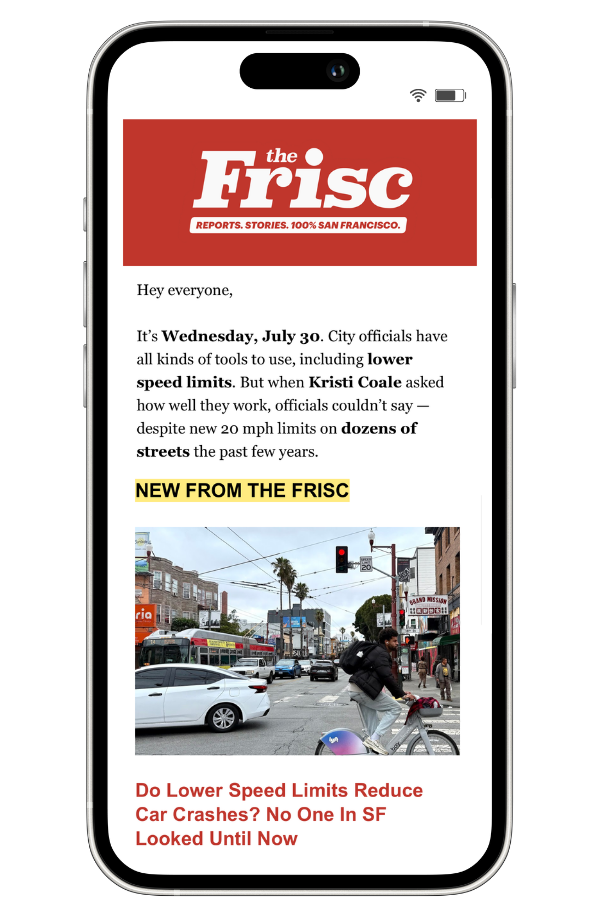
Last week, the seven members of the SF Municipal Transportation Agency board held a day-long workshop to discuss critical issues facing San Francisco’s transit and streets. They have plenty on their plate — budget woes, chronic driver shortages, the loss of riders who used to work downtown. At the end of the day, street safety was named as one of the top three priorities by all but one board member.
A new report card released this week could add more pressure, documenting how more than half of SF’s most dangerous streets are still waiting for major fixes despite City Hall’s promises to move fast and cut through red tape.
“Safety on our streets is a huge area we have got to get our arms around, as traffic is really fast,” SFMTA board vice chair Gwyneth Borden said at last week’s workshop. “Lots of people run red lights all the time, it’s really scary.”
San Francisco made its Vision Zero pledge in 2014 to eliminate traffic deaths by 2024. It isn’t going well. Last year, the city suffered the most traffic deaths — 37 — since Vision Zero began. Nineteen of those deaths were pedestrians killed by cars.
For context, consider this: SF has averaged 49 homicides a year since 2018. The gap is not very wide.
SFMTA board chair Amanda Eaken, who prompted the poll about priorities, said she is forming a subcommittee to examine SF’s Vision Zero strategy. (She said she had floated this idea last year, to no avail.) The subcommittee, Eaken said, will “get into the details of Vision Zero in a way that’s not possible before the full board, given everything else we need to cover.”
Advocacy group Walk SF’s new report card shows how the city is unlikely to meet the Vision Zero deadline, now less than a year away, even with its quick-build program, launched in 2019 to push faster fixes that require less bureaucracy and less construction. Mayor Breed touted the quick build program in 2021 as part of a redoubled effort to hit Vision Zero goals.

The report’s focus is on the city’s “high injury network,” where 68 percent of crashes happen on only 12 percent of SF’s roads. Walk SF, using city documents, public information, and interviews with SFMTA, says 28 streets have planned improvements upcoming, but 75 more have yet to reach the drawing board.
“With the Vision Zero decade coming to an end, obviously you would have wanted to bring some improvements to all of the high injury network,” Walk SF spokesperson Marta Lindsey told The Frisc.
SFMTA spokesman Stephen Chun says the agency is committed to quick build improvements to all of the high-injury network by the end of 2024. “We have numerous projects already in the pipeline, and we’re working on a comprehensive inventory of the remaining changes needed to ensure we meet this important goal,” he said. The quick-build budget was $14 million in 2022.

The Walk SF report looks at high injury network streets in each supervisorial district, showing what’s been upgraded and where work needs to happen. It compiles crash data on fatalities and injuries — collected by SFMTA, the police department, and the public health department — between 2014 and September 2022.
Districts with the highest percentage of streets with safety upgrades are D6, which includes South of Market, and D5, which includes the Tenderloin. The Tenderloin, which was the first to get a blanket 20-MPH speed limit, has seen several other upgrades such as a lane reduction and painted buffer to slow traffic on Leavenworth Street. In SoMa, 6th Street has had quick build improvements, including a lane reduction and left-turn restrictions.

The district with the lowest percentage safety upgrades is D11, which includes the San Jose Avenue corridor that runs by Balboa Park.
The Walk SF report also includes a call for two major changes citywide: an expansion of left-turn calming and a comprehensive speed plan for the city. Studies show that lower speeds lead to less death and severe injury.
A tale of two streets
It seems counterintuitive. SF has the emptiest downtown in the nation, with offices remaining stubbornly vacant, yet car traffic in and around SF has returned to pre-COVID levels, according to a 2022 analysis by INRIX, a transportation analytics company. It shows that drivers lost an average of 97 hours crawling along congested roadways, the same as 2019. The SF County Transit Authority congestion tracker shows traffic in the Tenderloin, SoMa, and Mission creeping closer to pre-pandemic levels, particularly in the afternoon and evening.
Crowded streets can lead to a lot of frustrated drivers, and streets that offer a cut-through to get around congestion see more cars, faster speeds, and drivers running red lights and stop signs. That’s why the Tenderloin, where most residents don’t own cars, had an urgent need for neighborhood-wide fixes to slow down commuters cutting through to get across the city.

Many SoMa streets serve a similar “pass-through” function. The neighborhood shows why changes need to happen on more than one street at a time. Both Harrison and Folsom streets are one-way, multi-lane streets that lead to freeway onramps. Folsom has received several upgrades, including concrete bus islands, a reduction of lanes from five to three, and a protected bike lane. Harrison remains a five-lane street.
LIndsey said Walk SF members monitored both streets for a 2022 report. Using a speed gun, members found stark differences in driver behavior. The average speed along Folsom’s three lanes was 18 mph. Along Harrison’s five lanes, the average was 28 mph, and the fastest went 47 mph. “More lanes means more people can be maniacs when driving,” Lindsey said.
SFMTA highlighted Folsom Street last year as part of its Safe Streets Evaluation Summary, which highlighted a selection of quick build and capital projects completed over the five years ending in 2022. “The evidence is clear that quick build projects work,” said SFMTA spokesman Chun, who noted that for pedestrians and cyclists, injuries were down more than 30 percent around the 18 projects noted in the summary.
Advocates like Lindsey agree: the failure of Vision Zero even to reduce street deaths doesn’t mean improvements don’t work. Instead, she said, we should ask where SF would be if it had moved faster to fix most of the city’s high injury network. “You need improvements to all streets so that together, they work to lower the crashes,” Lindsey says.
Correction: A previous version of this story gave outdated figures to describe the city’s high injury network. SF updated its analysis in November 2022.