


The eight-day tenure of Beya Alcaraz as the Sunset District’s supervisor was a shock from start to finish.
Mayor Daniel Lurie appointed Alcaraz to fill the seat left vacant after District 4 voters recalled Sup. Joel Engardio in September. A total political novice, the 29-year-old Alcaraz had a few years of pet store ownership as her main qualification.
Within days, her former shop became an albatross. The new owner revealed photos, videos, and other evidence of Alcaraz’s mismanagement, including her texts that seem to brag about paying workers under the table and other tax dodges.
What wasn’t a shock: This was all happening in District 4. Alcaraz’s unceremonious sendoff was the latest in a string of notable, bizarre, even criminal supervisorial situations in the western district, going back to its first representative in the early 2000s.
SF once held at-large elections for its 11 supervisors. But in 1996 voters approved an 11-district plan to give neighborhoods more local control, and district elections began in 2000. Boundaries have shifted here and there since then, but District 4 has always been the Outer Sunset District, and perhaps a bit more around its edges.
Even with its semi-suburban vibe and foggy chill, the Sunset has always been a complicated place for politics. It’s one of SF’s more conservative areas, at least by Bay Area standards. For example, while the Sunset voted decisively for Kamala Harris in the 2024 presidential election, her support was notably softer here than in many other neighborhoods.
The neighborhood is “bifurcated” by language, says SF political consultant Jim Ross. Planning Department data show 46 percent of district households are English-speaking, 44 percent speak an Asian or Pacific Islander language, and 42 percent of residents identify as immigrants. (Alcaraz touted her own Filipino roots.)

“My wife’s family has lived in the Sunset for 50 years,” says Daniel Ramirez, founder of the Irving Street Merchants Association. “It was a huge Irish community, and then Chinese immigrants worked their asses off to come out here and buy homes too.”
In a statement announcing Alcaraz’s resignation last week, Lurie talked up her “deep roots” in the neighborhood and said, “I’ve heard again and again about the fraught politics that have divided District 4.”
That could have simply been a reference to the Engardio recall, which was spurred by his successful campaign to close the Great Highway to cars.

Engardio’s election itself was full of D4 oddness. His main foe, the incumbent Gordon Mar, was the first sitting supervisor to lose re-election since 2000. Engardio had run unsuccessfully in another district multiple times; he finally won in 2022 by just a few hundred votes. He had only recently become a D4 resident because of redistricting.
On its own, the Mar-Engardio saga would be prelude enough to the Alcaraz debacle. But as they used to say on late-night TV commercials: But wait, there’s more.
Never a dull moment
“We’ve had a few corrupt supervisors,” says Judi Gorski, spokesperson for Concerned Residents of the Sunset. “People should be vetted very carefully.”
The first one, Leland Yee, set quite a precedent. Yee had already served several at-large terms on the board before his D4 election in 2000.
He skirted around controversy many times during his years in SF politics, including cops stopping him twice for allegedly cruising for sex workers in the Mission, and allegations that he lied about his home address to qualify his kids for a better school.

But he kept his official record clean until 2014, after he had climbed the political ladder to a seat in the state legislature. That year, the FBI arrested Yee on charges that included racketeering, bribery, and arms trafficking, in an elaborate plot with Chinatown gangsters and Filipino separatists.
He pled guilty and served more than four years in prison. Despite all this, more than 380,000 people cast a ballot for Yee in the 2014 California secretary of state race.
There’s no indication Yee committed these crimes during his two years repping District 4 in City Hall. That’s not the case for one of his successors.

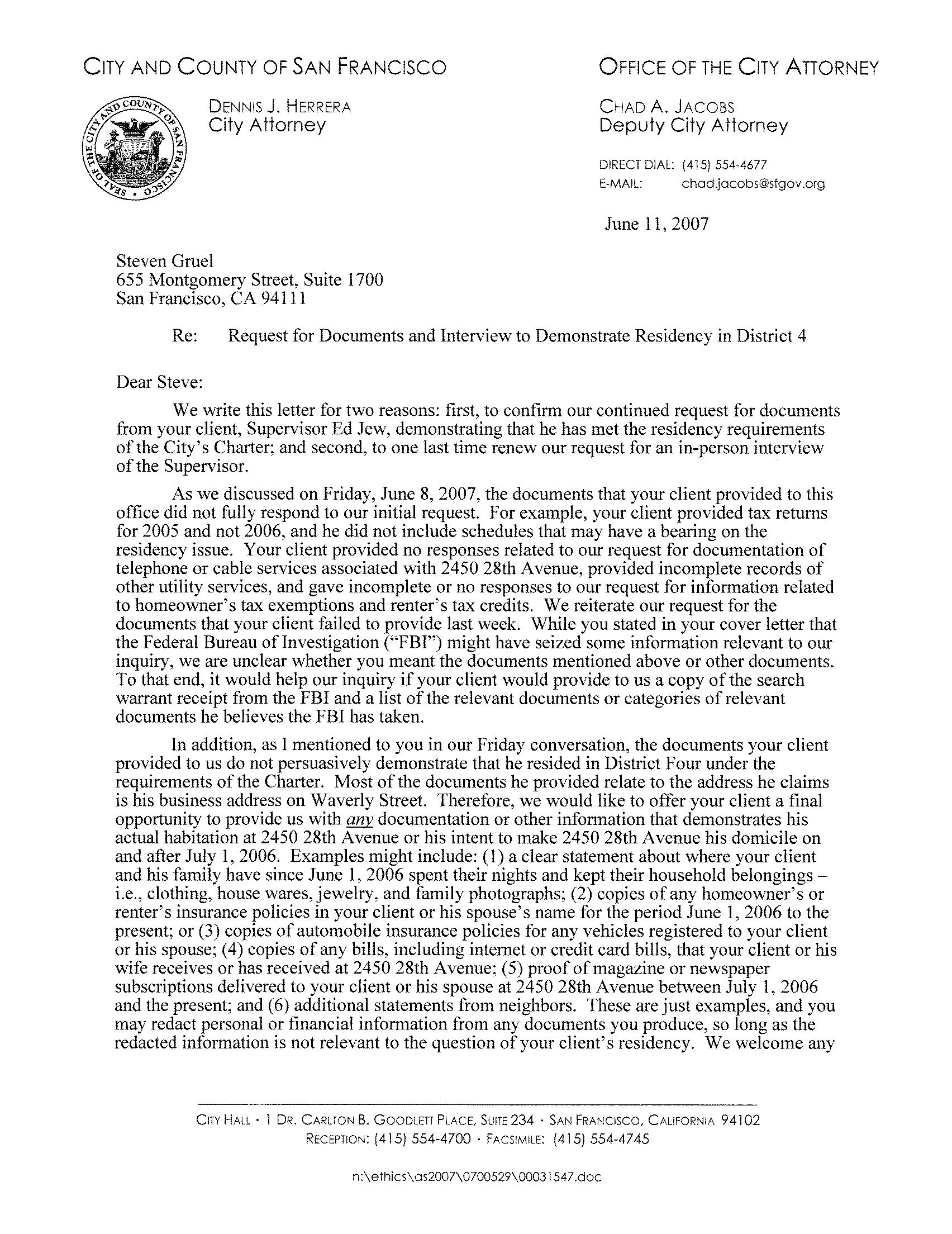
Ed Jew, a Chinese-American community organizer, was elected in 2006. He had been in office less than a year when the FBI raided his office and accused him of extortion. Jew had demanded $80,000 from an Irving Street boba shop and $4,000 from a competing business for help with city permits.
Instead, the owners called the FBI, and Jew unwittingly accepted cash from an undercover agent. The investigation also turned up evidence that Jew didn’t even live in District 4 — or in San Francisco at all — when he took office.
(Click below to see then-City Attorney Dennis Herrera’s letter to Jew’s attorney requesting evidence of his client’s D4 residency.)
The city charged him with perjury in a rare two-fer of criminal scandals, and he was sentenced to more than five years in federal prison. After his release, he spent an extra month in SF County jail for the perjury.
Between Yee and Jew was Fiona Ma, who is now the California state treasurer. Ma didn’t hit political speed bumps in San Francisco, but in 2021, a former staffer filed allegations of sexual harassment against her. Ma denied the charges. The staffer accepted a $350,000 settlement from the state in 2024.

Carmen Chu, now SF city administrator, succeeded Jew without scandal or indictment during (or after) her eight years. Then came Katy Tang, now the city’s Office of Small Business director. The only oddity of Tang’s tenure was how it ended: she ambushed supporters with her decision not to seek reelection hours before the campaign filing deadline. (Tang declined to comment for this story.)
Her sudden exit set up Mar’s unexpected win in 2018, his own surprise loss to Engardio, and all the mess that has followed. When a butterfly flaps its wings on the Great Highway, it can create a tempest at City Hall.
If you build it…
The Sunset is hardly the only SF neighborhood to supply political scandal. But recent District 4 supervisor history does give reason to wonder if there’s particularly bad karma on the west side. The latest foment is that leaders aren’t listening to their constituents.
“People want a supervisor who really represents them,” says Taraval Street hardware store owner Albert Chow, who helped recall Engardio. Chow says the mayor’s office interviewed him as a candidate for the D4 seat before tabbing Alcaraz.
All San Francisco politics come back to real estate in the end.
political consultant jim ross
In one sense, Alcaraz couldn’t have been more representative: born, raised, and schooled in the Sunset, then trying her hand at small business ownership there.
Chow and others who have gained a higher profile via the recall now say Engardio’s tone-deafness around Sunset Dunes Park — the former Great Highway — also included his support for the mayor’s upzoning plan, which would allow taller, denser housing across District 4 and other neighborhoods. (In 2024, Chow objected to an affordable housing proposal that, at eight stories, was too tall: “The question is, do we have the capacity?”)


“All SF politics comes back to real estate in the end,” Ross says, especially in the Sunset.
When Lurie named Alcaraz, it seemed reasonable to assume his team vetted her position on the housing plan. Within days it became clear there hadn’t been much vetting at all. Then she resigned, leaving the seat empty again and raising some hopes of a supervisor who might affect the outcome. (Lurie’s team reportedly has put in place a more stringent selection process.)


“We really feel that the discussions concerning the upzoning plan should be delayed until we have a supervisor” who can offer amendments on the neighborhood’s behalf, Gorski says.
Sup. Myrna Melgar, chair of the Land Use Committee and the legislative shepherd of the housing plan, tells The Frisc there’s probably no time left for amendments, even if a new supervisor took office immediately.
The plan must go to the Board of Supervisors for a final vote in December. Unless Lurie moves fast to replace Alcaraz, the chamber will only have 10 members. Melgar says she’s confident the plan will pass no matter who ends up filling the vacancy.
About the seat remaining unfilled, says Ramirez of the Irving Street Merchants Association, “part of me does say be careful what you wish for. We spent all this time and money on a recall and still don’t have the representation we want.”
Correction, 11/24/25: This story initially gave an incorrect last name for Daniel Ramirez. We apologize for the error.