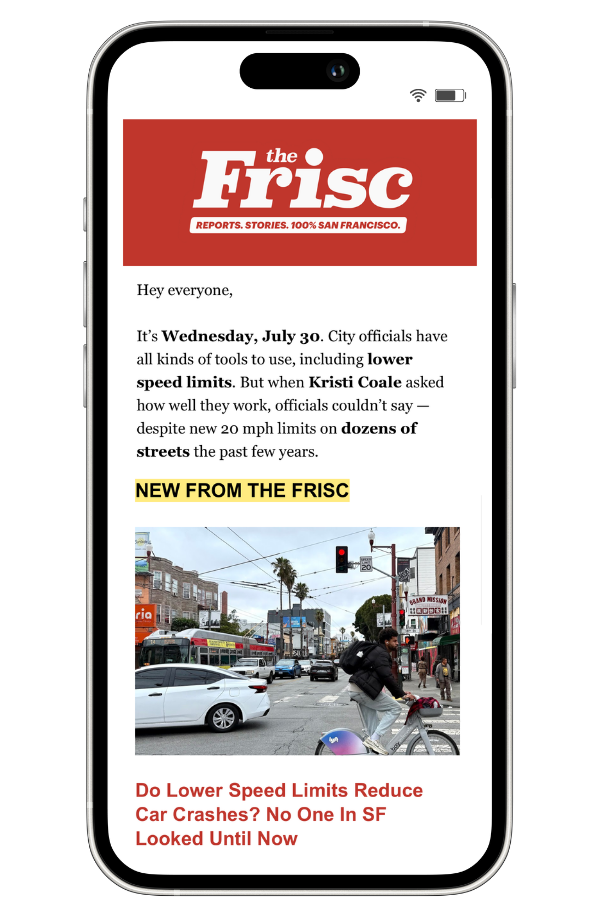
Ever find yourself having to step aside on a sidewalk to make way for bicycles — and now electric scooters? It’s maddening, especially when I’m walking with my young daughter. I absolutely fume when riders come at us at full speed — often while wearing a helmet to help ensure their safety — and sometimes staring down at their phones. Don’t they realize that they’re sending people to the hospital? And what reason would anyone have for riding on sidewalks in a crowded city with an expanding network of bike lanes?
In fairness, I often wonder if this is a real epidemic, or if I’m just overreacting to a few rogue riders as our city makes significant gains in accommodating much-needed alternative modes of transportation.
I needed answers and, if you walk the sidewalks of San Francisco, I’m guessing that you’re curious too.
I decided to hit the streets and gather some data. I posted up at 20 different locations — first on streets with no bike lanes to see how many riders chose the sidewalk over the street. I observed a total of 169 riders go by on bikes and electric scooters, and found that 20% of all cyclists, and 37% of all electric scooter riders, opted for the sidewalk. An overall 22% of a population of riders that has nearly tripled over the past ten years. This isn’t just me being a curmudgeon. Sidewalk riding is a real thing.
Not every street has a bike lane, and I can understand why many riders (including me) don’t want to be in the street without one. But the city has planned carefully. In the most heavily-trafficked neighborhoods along Market Street, in Hayes Valley, and in SOMA, a rider doesn’t have to sidestep more than a street or two to find a lane.

For example, Market Street has bike lanes, but adjacent Mission Street does not. Do riders take the time to sidestep one block from Mission to use the Market Street lane to avoid inconveniencing people on the sidewalks? I counted rider traffic on both streets to try to find out. I found that 94% of all riders on Market Street used the bike lane. But down on Mission Street, 23% of riders were on the sidewalk. It’s one block out of their way! Is that really too much to ask?
But that’s not the worst of it. Among the 6% of riders on the Market Street sidewalk were riders on the opposite side of the street from the bike lane headed in their direction of travel — riders who couldn’t be bothered to cross the street and use the bike lane. These data tell us that many riders need these bike lanes to be convenient, and for some, I mean really convenient.
Throwing around 2,500 pounds doesn’t just make sidewalk riders rude, it makes them surface-based cruise missiles.
After a total of four hours across 10 days on the street, I had the evidence I needed to justify being mad at these itinerant, inconsiderate, ignominious sidewalk riders.
Then I started thinking about my own driving habits.
When I’m in the car, do I really choose my routes in the interest of rider and pedestrian safety? Or do I just find the fastest route available and let it rip? I wondered if anyone had collected data on drivers similar to what I had done with bikes and scooters. It turns out, they have. The SF Municipal Transportation Agency’s traffic volume data confirm that drivers all over the city strategically use small streets as shortcuts between major thoroughfares — through neighborhoods that don’t enjoy protections against high-speed, high-volume traffic. Neighborhoods fight back by installing speed bumps, but the cars keep racing through.
Now that I think about it, when I’m using a GPS routing app, do I ever stop and consider the consequences of using the shortcut that my app just came up with? I don’t and not many others do, either. Cities everywhere are vexed over the problem of cars being routed through neighborhoods that aren’t set up to deal with them.
So admittedly, when I’m cramming my car through neighborhood streets so I can save a little time, I’m at least somewhat as guilty as the sidewalk riders I’m complaining about.

But do these sidewalk riders really need to be coming at me full speed? Don’t they know that force equals mass times acceleration — that simple equation we learned in science class? Ballparking the crumple zones of the two human bodies being crushed together, a 180-pound rider traveling at 15 miles per hour might deliver about 2,500 pounds of force upon impact. Throwing around 2,500 pounds doesn’t just make sidewalk riders rude, it makes them surface-based cruise missiles.
And let’s think about what happens as a rider crashes into a pedestrian. Pedestrians instinctively put up their hands and forearms to shield themselves. But riders tend to keep their hands on the controls. They instinctively shrink their necks like turtles and present the crown of their heads for the impact. That’s why, if you sift through the emergency room data, you find plenty of fractured hands and forearms. But riders’ heads often penetrate these brittle defenses and break what lies behind them: noses, jaws, and teeth.
But then I realized who else has literally no clue about the forces with which they threaten others. While driving our cars at 35 mph, unlawful but hardly unusual on San Francisco streets, we can deliver about 35,000 pounds of force upon impact. Happily clueless and fear-free, San Francisco drivers continue to run red lights and often speed up as they head toward the crosswalk on the other side that is starting to fill with pedestrians. They make rolling right turns on red, scaring the crap out of pedestrians who are watching the walk sign to tell them that it’s now safe to cross.

Often on phones, heedless of public-safety billboards and laws, San Francisco drivers continue to post depressing numbers for pedestrian and cyclist fatalities (2.5 fatalities per 100,000 San Francisco residents vs. 1.4 per 100,000 in New York City). How many drivers know that 45 mph is “killer fast” — that when you hit a pedestrian or rider at 45 mph, they’re probably going to die? How many know the kinematics and biomechanics of what happens to pedestrians when you hit them going slower than 45 mph?
Could I be ragging on this population of bicycle and electric scooter riders mostly because it’s new? Maybe these riders are calling our attention to bad behaviors we’ve been dealing with for many years but we’ve been ignoring, repressing on six cylinders, as we speed around in our cars. Is there a sort of same-shit-different-vehicle phenomenon going on here?
Welcome to our brains on transportation — the activity that can instantly turn us into raging hypocrites. We complain about infractions committed by someone using one mode, but then we mindlessly commit the same infractions while using another mode. In the end, I realized that San Francisco does indeed have a sidewalk bike and scooter problem. But it’s just part of our larger, anybody-going-anywhere problem.

It’s important to realize that it will take more than bike lanes to fix our transportation problems. Even when the streets of San Francisco are gloriously striped with dedicated lanes for all, our paths will still meet at intersections: the deadliest scenes of all.
Reaching the zero-accident scenario that safety professionals dream about will require a long-overdue upgrade in the way we think as individuals about this cooperative effort in which one person’s life depends on the thoughts and actions of another. Sidewalk riders need to change their attitudes and their habits — and so does everybody else.
We can start by realizing that we don’t all belong to mode-specific gangs. (I like to imagine tattoos and leather jackets with footwear or minivan emblems embroidered on the back.) In reality, most of us are constantly switching between modes.

After having written this story I realize that I’m a safe pedestrian, a thoughtful bike, scooter, and skateboard rider, and an occasionally asshole driver. When I climb out of one seat and into another, it’s like a switch gets flipped in my mind. Buried deep in my automated routines lurk some habits and attitudes that I need to revisit and improve.
San Francisco’s expanding multimodal transportation network makes us pioneers on the world transportation scene. Unlike other cities, our problems are aggravated by the excruciatingly nice weather that encourages throngs of smart, talented people to get jobs, move here, and use our transportation network. It’s time we match our leading-edge economy with leading-edge community attitudes.
We can start by introducing the world to the Golden Gate Golden Rule: Run into others as you would have them run into you. Preferably never, but if you must, do it really really slowly.