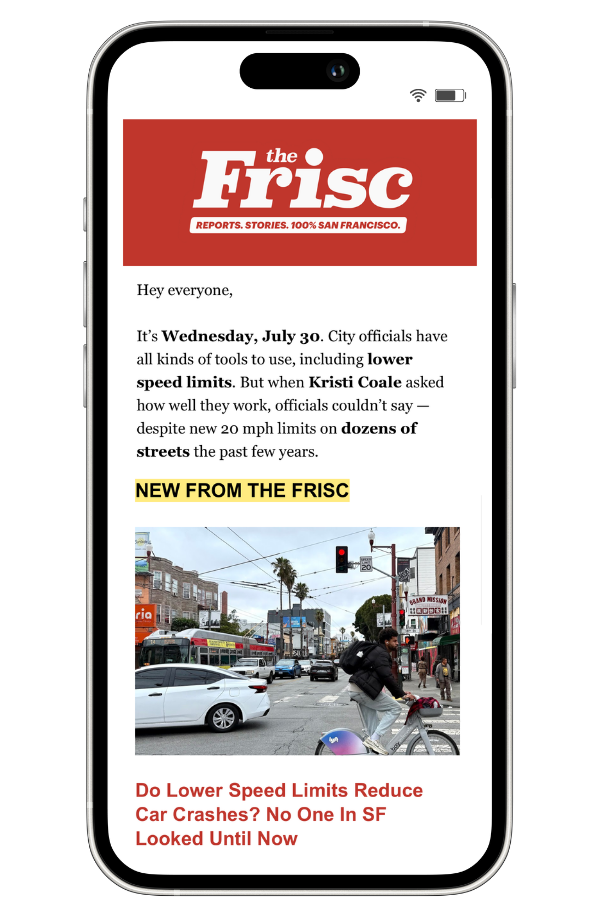


During the pandemic, San Francisco bicyclists got a big boost. Arguably the biggest came in the geographical center of the city, around Haight Street.
Thanks to the Slow Streets program and a new protected bike lane that runs along the Panhandle, riders suddenly had wider, safer routes to make the crucial connection between Golden Gate Park, SF’s western neighborhoods and the east: Civic Center, Downtown, the Mission District, and more.
As they say in old TV commercials: But wait, there’s more. Or there should be. In 2021, officials approved funding for a second protected lane along the Panhandle on eastbound Oak Street.
It would mostly mirror the existing protected lane, which runs along Fell Street and keeps westbound bikers off the Panhandle’s paved path.
But eastbound cyclists share that path with walkers, runners, and the occasional brave rollerblader. Bike advocates say they need a new protected route. Neighborhood activists want them off the current one. “The multi-use pathway is simply too small to accommodate bikes and pedestrians safely, as anyone can now experience,” a Haight-Ashbury Neighborhood Council board member wrote to members last March.
Three years since officials earmarked nearly $400,000 for the Oak plan, it’s still no done deal. After SF Municipal Transportation Agency engineers gave it a green light last November, there was some anticipation the agency’s board would vote on it in December, but it was never scheduled. SFMTA spokesperson Michael Roccaforte says only that a vote will come “sometime in the coming months.”
While the new bike lane, a long time in the making, has drawn little attention so far, that could change. The project has a key element that in SF is a magnet for neighborhood ire: the removal of parking spaces. Drivers, merchants, and some neighbors feel increasingly threatened as the city continues to make more room for bikes, pedestrians, and other alternatives to cars.

But pedestrians and cyclists are also frustrated that safety upgrades have done little to reduce traffic deaths and injuries. Last year was the deadliest year ever under the city’s Vision Zero pledge, launched in 2014. There were 41 traffic fatalities, 24 of whom were pedestrians.
Can a new bike lane for eastbound bikers, one block away from the already popular Slow Page, entice more people to get on two wheels for big trips across the city?
Troublesome crossings
Oak is one of San Francisco’s busiest streets, a one-way thoroughfare for drivers heading downtown or to the freeway. It’s also one of its most dangerous and part of SF’s high-injury network, the 12 percent of streets where the majority of collisions happen.
Between Baker and Stanyan streets – three quarters of a mile – the car lane closest to the park will turn into a bike lane. Bikes and traffic will be separated by a row of parking spaces, with paint and plastic posts adding extra demarcation. Going from four car lanes to three is what’s known as a “road diet,” and a growing number of studies have shown that it can slow traffic and reduce crashes.
If the parallel Fell Street bike lane, which opened in 2020, is any precedent, Oak might see slower cars with little disruption. With the bike lane in place, traffic speeds on Fell over the next six months dropped between 5 and 14 percent, according to SFMTA, while the average time to drive that stretch only increased by a few seconds.

Most notably, injury collisions along Fell dropped by 45 percent after the bike lane was installed, according to SF Open Data. Most crashes involved cars hitting cars or other objects – not bikers or pedestrians. The most dangerous intersection on this stretch, where Fell meets Masonic Avenue, is where cars were more likely to hit people.
Even here, collisions dropped after the new bike lane. An even bigger improvement came in 2008, when SFMTA installed a separate signal — the first of its kind in SF — at the intersection for bikers and pedestrians.

Designers of the upcoming bike lane have heeded the lesson. The Panhandle crossing at Oak and Masonic is also precarious. As pedestrians cross, cars can turn left from Oak onto Masonic into the crosswalk through a flashing yellow left-turn arrow. Just like on Fell, SFMTA will add a designated signal, as well as a special crosswalk just for bikes.
By SF standards, objections have been relatively muted — though still familiar.
Space invaders
Thanks to a new state law, San Francisco is removing thousands of parking spaces near crosswalks to improve driver visibility and pedestrian safety. Oak will already lose 26 spots to this so-called daylighting. Now the new bike lane will remove 23 more, mostly on the block between Ashbury and Masonic to accommodate two left-turn lanes.

This could be a problem for three nearby nonprofits: the Family and Child Empowerment Services of SF (FACES SF), which includes a preschool, the Urban School, and Saint Agnes Church. Dan Miller, Urban’s head of school, says the private high school “fully support[s] improving safety at Masonic” and is a “strong supporter” of Slow Page, where the campus is centered.
The school benefits from the Slow Streets program because its students cross Page several times a day to go from one side of campus to the other. It has some staff parking in a garage it shares with Saint Agnes, but Miller would like to see the city “explore all options” and ideally preserve some spots along Oak.
Saint Agnes and FACES SF did not respond to requests for comment.

Beyond that, opposition has been low-key. In a two-week open house and survey on the project last July, SFMTA gathered 246 responses, with 83 percent in support of the project and only 10 percent opposed. During the Nov. 8 hearing, some commenters worried about traffic congestion, parking loss on Baker, and signal timing changes. After that meeting, the Haight-Ashbury Neighborhood Coalition said members had similar concerns.
Of course, there’s always potential for more outcry. The upcoming SFMTA vote — when it’s scheduled — will offer a prime opportunity.
Why another bike lane?
If approved as-is, the project will do something rare in SF — give cyclists more than one way to route through the same neighborhood. Just one block over, bikes can travel between Golden Gate Park and Civic Center in either direction on Slow Page.
Rachel Clyde, a San Francisco Bicycle Coalition community organizer, says a dedicated lane on Oak is important because members don’t feel safe sharing Page with cars. “Protected infrastructure is really important,” she tells The Frisc, adding there are still concerns about the effectiveness of the Slow Streets program.
The Frisc’s recent examination of citywide Slow Street data shows Page among the top four in injury collisions per month.

As for the shared Panhandle path — the only car-free option for eastbound cyclists — Clyde says it gets particularly crowded on the weekends.
In its March note to members, HANC called for bikes completely out of the Panhandle once the Oak bike lane is installed. This is because more bikers — including those on fast-moving e-bikes and e-scooters — are riding along the narrow, multi-use path on the north side of the Panhandle, putting pedestrians at risk.
While most of the Oak Street bike lane will be on the pavement, a small section will merge up on the southern side of the Panhandle in the approach to the light at Masonic to allow for a shorter second left-hand turn lane. Other changes through the project include repurposing one eastbound lane on JFK Drive to allow for a wider bike lane and painted buffer, a protected bikeway southbound on Baker between Fell and Oak, and a separate bike signal at Baker.
Beyond opening up another pathway for bikes, the Oak Street project reflects a larger desire for the city to make good on its promises — in this case a three-year-old promise. Oak is part of the Quick Build program, designed to expedite safety measures by using low-cost materials. “We need to see Quick Builds happening quicker, ” Clyde says.
Advocates say it’s part of a larger pattern. A February 2023 report from Walk SF documented how more than half of the 103 streets in the high-injury network had yet to receive safety treatment. By December 2023, the agency was able to get this down to one third. The report included a to-do list for safety improvements at all 925 intersections in the high-injury network.
Last month, SFMTA reported that it “completed five miles of improvements on six separate corridors” through Quick Build and that it had “installed daylighting at over 258 locations, among other safety treatments.”
Oak is on their list for early 2025. For now.
Eff SFBC